
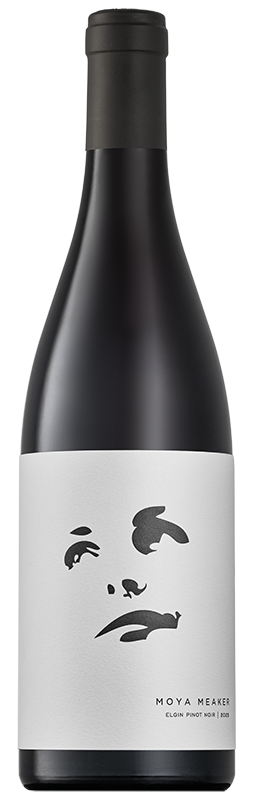
Moya Meaker Pinot Noir 2025
Winemaker: Jean Smit
Cultivar: 100% Pinot Noir
Origin: Habibi Farm, Elgin
The 2025 Pinot Noir manages to present as unusually powerful, without ever being forceful. The vanguard shows fragrant raspberry, fresh fennel, and red cherry, followed by a palate of rare concentration for the cultivar. Notes of cedar spice frame the vivid raspberry and cherry fruit, which seems to rise in intensity as the palate evolves. Tannins are fine, with a pleasant cocoa powder texture. The long savoury finish allows those herbal fennel notes to linger alongside richer morello cherry touches.
Where 2024 was a warm season in Elgin, 2025 was cool from the very start. In spring, a warm October triggered strong, luxurious canopy growth, providing some protection for the blossoms during a windy flowering season.
The summer was notably lacking in heat events, with fewer days above 33 °C than in the warm 2024 season. February was exceptionally dry, which kept disease pressure low and the fruit clean. Elgin’s harvest opened roughly two weeks later than usual, and the Pinot Noir was given the whole of that late season to ripen slowly and evenly.
Moya Meaker’s Pinot Noir is grown on five distinct blocks across a single slope at Habibi Farm. The slope’s slight convexity gives rise to aspects ranging from south to southeast, with the 3.12 hectares of vines planted in 2010, making them 15 years old at the time of the 2025 harvest. Rooted in ancient Bokkeveld shale soils, rich in clay, these vines are trained for precision — allowing for airflow, sun moderation, and optimal ripening.
Clone 667 and 777 Pinot Noir vines benefit from Elgin’s hallmark misty mornings and cool summer days, ensuring slow ripening and the development of fine structure without sacrificing fruit purity.
Harvested by hand from 11 – 13 February, the Pinot Noir fruit was destemmed and gravity-fed into tulip-shaped concrete vessels. Whole berries were preserved to allow for gentle fermentation. The wine spent ten days on skins with delicate pump-overs twice daily to extract structure without overworking the fruit.
Malolactic conversion occurred spontaneously in 300L Burgundian oak barrels (20% new). The wine remained on its lees for 11 months, without racking, giving ample time to build texture.
This wine will be at its most expressive within five years of vintage, but with careful cellaring will evolve gracefully for up to a decade.
TOTAL PRODUCTION: 8584 x 750ml and 200 x 1500ml
BOTTLING DATE: 12 January 2026
Origin: Elgin
Alc: 13.92%
pH: 3.39
TA: 5.7 g/L
RS: 2.0 g/L